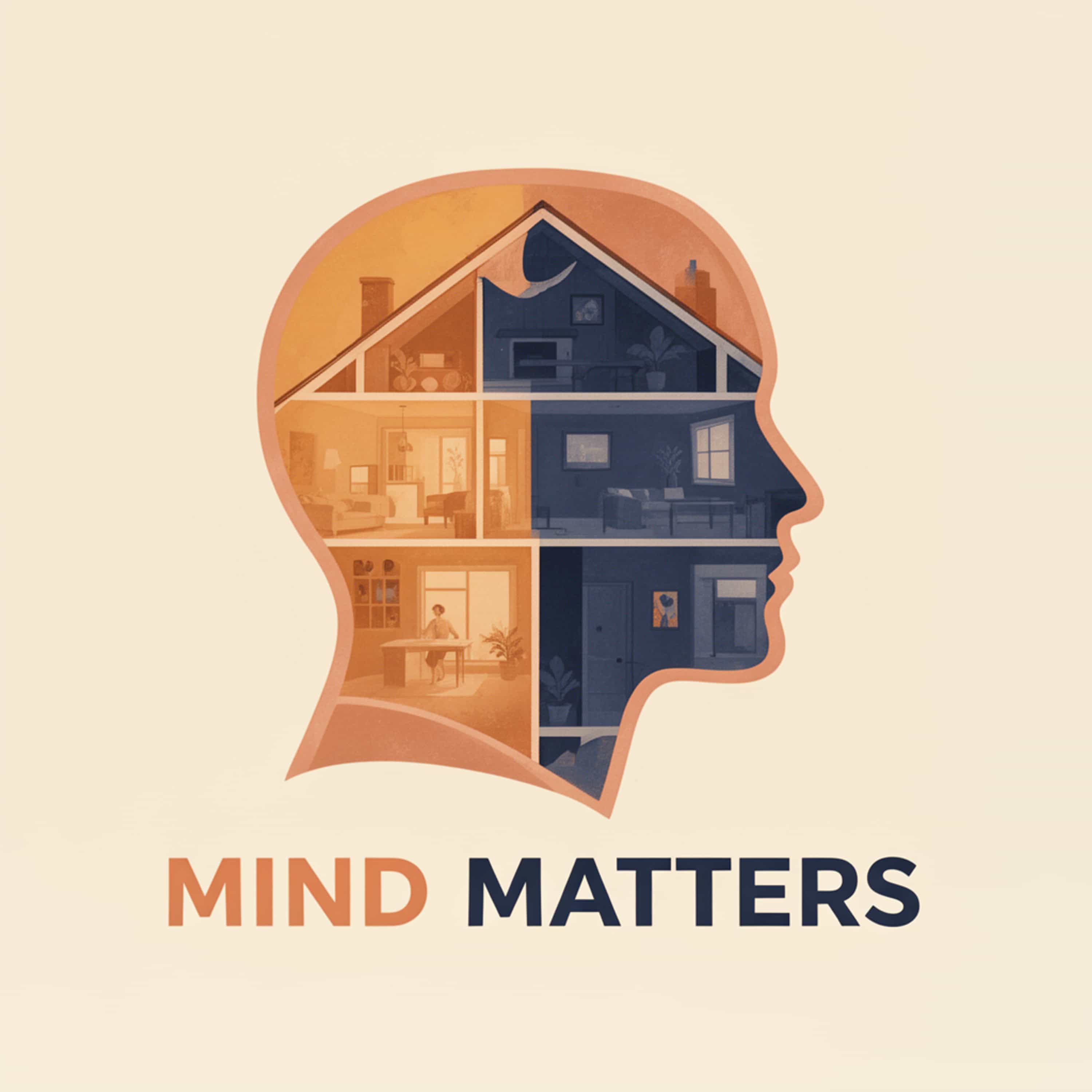
1 - The House and Its Residents
In this episode, Dr. Toye Oyelese introduces the Mind Enclosure framework, using the metaphor of a house filled with distinct internal 'residents' to help listeners make sense of their inner lives. Explore how different parts of yourself form, manage power, and can be guided through understanding—not conflict.
Chapter 1
The House Metaphor
Toye Oyelese
Welcome, and thank you for joining me for this very first episode of Mind Matters. I’m Dr. Toye Oyelese—if you’re here, I already know you’re curious about the strange cast of characters that seems to live inside all of us. Or maybe it’s just me, but I doubt it. Let’s start with a question I hear from patients and friends alike: Why do I sometimes behave in ways I honestly can’t explain, like I’m watching myself from the sidelines? Why do I have these regrets—say, from a heated argument—when it’s almost as if I turned into a different person for a moment?
Toye Oyelese
It’s funny. We’re so used to hearing 'Be yourself' or 'Know yourself', as if the self is this single, unified thing. But, you know, coming from Yoruba culture, there’s this old saying: "a house divided cannot stand." And people often think it’s about getting rid of differences—kind of forcing harmony. But, really, it’s about figuring out how all these differences can coexist... and sometimes, clash.
Toye Oyelese
The way I see it—and this isn’t just me, there’s plenty of old wisdom and new research in psychology and neuroscience to back it up—your mind is more like a house. And in this house? There are lots of persistent residents, not just fleeting guests. Each one, a different aspect of you. None of these residents are separate personalities, let’s be clear—they’re all you. Just... different modes, built up over time.
Toye Oyelese
Now, there are some residents you’re probably proud of. Others, you might wish would just pack up and leave. But here’s a frustrating truth—once a resident moves in, they don’t really leave. Trust me, I’ve tried! I remember my early days practicing medicine out in a tiny BC town. Picture this, I’m leading a team, and I’ve got my own worries—the nurse who’s a genius at wound care, the firefighter who doubts every doctor, and inside my own head this anxious critic who keeps second-guessing everything I say. Couldn’t evict any of them, inside or out. But I had to find a way for all those voices—mine and theirs—to work together rather than letting just one run the show.
Toye Oyelese
So this is the Mind Enclosure model—your personality as a house full of residents. The question isn’t, 'How do I kick out the ones I don’t like?' It’s, 'How do I manage the house so the right residents are speaking at the right times?' Let’s open some doors and meet these folks.
Chapter 2
Meeting the Residents
Toye Oyelese
Okay, picture your own internal house. You might not have noticed all the residents yet, but I’ll bet a few are familiar. There’s the Child, who’s playful, loves to laugh, gets excited—maybe even throws a tantrum once in a while. Then there’s the Protector, who jumps to your defense, sometimes a bit too quickly—either getting defensive, raising their voice, or just withdrawing from a situation.
Toye Oyelese
There’s probably an Achiever living in there too—always chasing the next success, pushing you to perform, sometimes at the expense of actually enjoying the things you achieve. Then, the Moral Compass: that resident who’s always worried about being a good person, about right and wrong. Last but not least, the Strategist—the planner, the calculator, always thinking two moves ahead, sometimes even when you just want to enjoy the moment.
Toye Oyelese
I want to make one thing clear—these aren’t just moods that float in and out. They’re like tenants who have lived with you for years, maybe decades. They’re patterns, learned over time. Sometimes you notice who's running the house, sometimes you don’t. For instance, I remember a patient early in my Canadian career who looked at me with real skepticism—like, 'What can this young immigrant possibly know about my health?' At first, I thought I just had to reason with him, show my credentials. But looking back... it wasn’t logic operating in me. My Protector had jumped into the driver’s seat. Suddenly I was talking faster, getting defensive, almost anxious to prove myself. That wasn’t just a passing mood. That was a big, familiar resident grabbing the microphone.
Toye Oyelese
You might have your own examples. Maybe when you "lose your temper" with family, that’s a resident stepping up. Or when you put work ahead of your partner, the Achiever is running things. Maybe you keep quiet in meetings, and that’s the Child who learned—maybe a long time ago—that silence is safer than speaking up. Your house has its own population, but those patterns, those residents? They’re not going anywhere.
Chapter 3
How Residents Gain Power
Toye Oyelese
So, how do these residents decide who gets the biggest bedroom, so to speak? Here’s a principle that's simple but not always easy to follow: attention is currency. The more time and energy you give to a resident, the more powerful they become. What you focus on grows.
Toye Oyelese
And—and here’s where it gets tricky—even negative attention is still attention. If you spend your day wrestling with your inner critic, or trying to shout down your Protector, you’re actually making them stronger. I know this firsthand. There was a period where self-doubt was, well, pretty loud in my house—I thought if I just worked harder to silence it, I’d get peace and quiet. But all that did was make it more insistent. Like whack-a-mole, the more you try to hammer it down, the more places it pops up.
Toye Oyelese
Here’s the actionable bit: instead of investing all your energy in wrestling the residents you don’t like, put your attention toward the ones you want to represent you. Want more kindness from yourself? Spend time nurturing the Warm Neighbor, not battling the Critic. Want more courage? Let the Adventurer come to the front. It’s not about fighting your residents. It’s about redirecting the spotlight.
Toye Oyelese
These ideas—well, they’re tools, not rules. Try them out. See if recognizing your own internal house helps make sense of those moments when you feel divided inside, when you act in ways that don’t match your intentions. Next time, we’ll dig deeper: Where did these residents come from in the first place? How do they form? And what happens if we go right back to their beginnings? Thanks so much for joining me—let’s keep exploring the house together.